UV coating in printing gives packaging a cleaner, glossier, more protective surface, but it can also create problems when brands use it without understanding the material, folds, artwork, and product type.
The finish of a package changes how people judge the product before they open it. A sharp logo, rich color, and clean surface can make a box feel premium. A scratched, dull, sticky, or cracked surface can make even a good product look cheap. That is why UV coating matters in custom packaging.
At the same time, UV coating is not a magic finish. It can crack near score lines, make handwriting difficult, show fingerprints, raise costs, create glare near barcodes, and require proper curing controls during printing. It may also be confused with UV coating for windows, UV coating for headlights, UV paint protection, UV wood finish, or what is UV coating on glasses, even though those belong to different industries.
This Packaging Hubs guide explains what UV coating is, how UV coating printing works, where UV coatings for printing help packaging, what drawbacks brands should consider, and how to decide whether UV gloss coating, UV spot gloss, dull UV, aqueous coating, lamination, or no coating is the better choice.
The Simple Answer: What Is UV Coating?
UV coating is a clear liquid finish applied over printed material and cured with ultraviolet light.
In printing, the coating is added after ink is placed on the substrate. Then ultraviolet light cures the coating into a harder surface. This finish can be glossy, dull, satin, raised, textured, or applied only to selected areas.
A buyer may search for the same idea using many different terms, including uvlack, uv coating, ultraviolet coating, ultraviolet coatings, uv coating printing, uv coating for printing, uv coatings for printing, uv coated printing, uv lacquer, uv varnish, uv curable coating, uv gloss coating, uv coating paper, uv coated paper, paper uv, paper coated, ultraviolet paper, uv coated, what is uv coating, what is a uv coating, what is uv coated, and what is uv varnish.
In packaging, UV coating is mainly used to make printed surfaces more attractive and more resistant to light handling wear. It can cover the full surface or only selected design areas. When only a logo, pattern, or product name is coated, the finish is usually called spot UV or UV spot gloss.
Why UV Coating Became Important for Packaging Buyers
UV coating became important because packaging is judged visually before it is judged technically.
Retail customers notice shine, contrast, color strength, and finish quality immediately. Ecommerce customers may judge a brand from product photos and unboxing videos before they even touch the package. In both cases, the surface finish affects perceived value.
A full UV gloss coating can make colors appear deeper. A spot UV logo can create a luxury effect on a matte background. A dull UV coating can protect the surface without making the box too shiny. A raised UV detail can add texture to selected artwork.
That makes UV coating useful for cosmetics, electronics, gift packaging, retail cartons, insert cards, product sleeves, display packaging, premium labels, and promotional mailers. It is especially helpful when the design depends on contrast, light reflection, or rich product imagery.
However, UV coating should still match the packaging purpose. A rustic kraft product may look better without gloss. A folding carton with tight creases may need coating knockouts. A food carton may need extra caution around food-contact areas.
How UV Coating Printing Works From Press to Finished Box
UV coating printing starts with a printed sheet, not a finished box.
First, the artwork is printed on paperboard, coated stock, card, or another approved surface. Then the UV coating is applied through flood coating, roller coating, screen coating, or spot coating equipment. After that, the sheet passes under ultraviolet lamps or UV LED curing systems. The coating reacts to the light and hardens quickly.
This process is often called UV finish curing. It does not work like simple air drying. The coating must receive the right UV energy, coating thickness, exposure time, and surface compatibility. If the curing is incomplete, the result may include odor, blocking, tackiness, poor adhesion, or surface failure.
A good UV coating project should consider ink type, paper stock, coating weight, artwork placement, score lines, folding direction, die-cutting, barcode zones, and final use. Packaging Hubs treats UV coating as part of the full package design, not just an afterthought added at the end.
What UV Coating Changes on a Printed Package
UV coating can change the visual, tactile, and functional quality of a printed package.
| Packaging Goal | How UV Coating Helps | Best UV Direction | Risk to Check |
| Stronger shelf appeal | Adds shine and contrast under store lighting | Full UV or spot UV | Too much gloss can look cheap |
| Premium logo effect | Highlights selected brand marks | UV spot gloss | Registration must be accurate |
| Richer product images | Makes dark and bright colors appear deeper | Full UV gloss coating | Fingerprints may show on dark areas |
| Refined luxury look | Adds protection without heavy shine | Dull UV or satin UV | Effect may feel too subtle |
| Better handling resistance | Adds a harder surface layer | UV curable coating | Not a replacement for structural protection |
| Better unboxing visuals | Creates contrast in photos and videos | Spot UV over matte surface | Needs clean artwork spacing |
| More tactile branding | Adds raised or textured detail | Raised UV or textured UV | Requires testing before production |
This is the real value of UV coating for packaging. It can help the surface communicate quality before the customer reads a single word.
Packaging Uses Where UV Coating Works Best
UV coating works best when the package depends on surface impact.
Cosmetic cartons, perfume sleeves, candle boxes, jewelry packaging, electronics cartons, skincare boxes, luxury product cards, and retail display sleeves often benefit from UV coating. These products compete visually, so the finish can help the packaging stand out.
Brands ordering custom packaging may use UV coating when they want the box to look more polished without changing the material, size, or structure. For example, a skincare brand can keep the same carton but add spot UV to the logo. A candle brand can use dull UV for a softer look. A tech brand can use UV spot gloss on dark artwork for sharp contrast.
Packaging UV also works well on insert cards, belly bands, hang tags, small retail sleeves, and promotional cartons. It is less useful when the package is purely functional, writeable, rustic, or meant for rough shipping.
UV Coating Types for Packaging Projects
Packaging buyers should choose the UV type based on the job the finish must perform.
| UV Finish | Packaging Use Case | Appearance | Buyer Note |
| Full UV coating | Retail boxes, product cards, sleeves | Full glossy surface | Best when the whole artwork needs shine |
| Spot UV | Logos, icons, patterns, product names | Selected glossy areas | Best for premium contrast |
| UV spot gloss | Luxury boxes, cosmetics, gift packaging | High-gloss detail | Works best over matte or dull backgrounds |
| Dull UV | Wellness, fashion, minimal packaging | Low-gloss protection | Better when shine should stay controlled |
| Raised UV | Premium names, seals, edition marks | Tactile raised effect | Needs artwork and proofing precision |
| Textured UV | Gift packaging, event packaging, specialty sleeves | Patterned surface feel | Should be sampled before production |
| UV varnish | Cards, cartons, labels, inserts | Clear protective finish | Printer terminology may vary |
| UV lacquer | Premium print finishing and specialty packaging | Hard gloss or lacquer-like surface | Chemistry differs by supplier |
This table prevents confusion. Asking for “UV” is too broad. The better request is full UV, spot UV, dull UV, UV varnish, UV lacquer, or raised UV based on the packaging goal.
UV Coating vs UV Varnish, UV Lacquer, and UV Lamination
UV coating, UV varnish, UV lacquer, and UV lamination are related, but they are not always the same.
UV coating usually means a liquid coating cured by ultraviolet light. UV varnish often means a clear UV-cured varnish applied to print. UV lacquer may mean a hard gloss or lacquer-like UV finish. UV lamination usually means a film or adhesive-based process, not only a surface coating.
UV laminating adhesive is another related term. It may refer to an adhesive cured with UV during lamination. That is different from applying UV coating to the top of a printed carton.
For packaging buyers, the practical question is simple. Does the finish need to protect the print, create gloss, highlight a logo, support folding, resist scuffing, or create a luxury feel? Once that goal is clear, the supplier can recommend the right finish.
UV Coated Paper and Paper-Based Packaging
UV coated paper is paper or paperboard that has a UV-cured coating on its surface.
It may be used for folding cartons, sleeves, labels, inserts, cards, brochures, postcards, retail displays, and packaging panels. UV coated paper can look brighter and feel smoother than uncoated paper. However, it may be harder to write on and may crack if coating crosses tight folds.
Terms like uv coating paper, uv coated paper, uv dull paper, paper uv, paper coated, ultraviolet paper, and uv coated all relate to treated paper surfaces. For packaging, the key issue is not only whether the paper is coated. The key issue is whether the coated surface can fold, glue, label, scan, and handle real use.
A flat insert card may handle UV coating easily. A tuck box with tight scores may need coating knockouts. A shipping sleeve may need uncoated label space. A food carton may need coating placement that avoids direct food-contact concerns.
Rigid Boxes and Premium UV Effects
Luxury packaging often uses UV coating differently from standard retail cartons.
A full glossy surface may not suit every premium brand. Many luxury products use matte lamination, soft-touch coating, or dull UV as a background, then add spot UV to selected artwork. This creates contrast without making the whole package look overly shiny.
For rigid boxes, UV can highlight a brand name, pattern, icon, monogram, product line, or seasonal detail. It can also help a box photograph better for ecommerce listings and unboxing content.
Rigid packaging usually gives UV coating a more stable surface than thin folding cartons. Still, the artwork should avoid tight edges, wrap lines, and areas where pressure may distort the finish.
Mylar Bags and Flexible Packaging Need Separate UV Planning
Mylar-style packaging behaves differently from paperboard packaging.
Flexible packaging bends, seals, folds, and moves. A finish that looks great on paper may not perform the same way on flexible film. Ink adhesion, lamination, heat sealing, surface flexing, and product handling all affect the result.
For mylar bags, UV-style gloss or spot effects should be tested on the actual film structure. Packaging teams should not assume that UV coating paper rules apply to pouches. A flexible pouch may need film-specific inks, lamination, varnish systems, or gloss effects designed for that substrate.
This matters for snack packaging, cosmetic pouches, cannabis packaging where legal, supplements, samples, and retail flexible packs. The surface may look small, but the finishing decision is technical.
Benefits of UV Coating for Custom Packaging
UV coating offers several practical benefits when used correctly.
It can improve color depth, add shine, highlight selected design areas, improve light scuff resistance, and make packaging look more finished. It can also cure quickly when the correct equipment and chemistry are used. Fast curing can help production flow, although final turnaround still depends on print method, die-cutting, finishing, and order size.
EPA lists UV-cured coatings among low/no VOC/HAP coating approaches. That does not mean every UV coating is automatically sustainable, but it does show why UV curing is often discussed in lower-emission coating conversations.
RadTech also explains that UV and electron beam curing systems can reduce environmental footprint in some manufacturing situations. For packaging buyers, the safest approach is to ask for supplier documentation instead of assuming every UV finish has the same environmental profile.
Drawbacks of UV Coating Brands Should Consider
UV coating can create problems when it is chosen only for shine.
It may crack near score lines if the coating is too thick. may make the surface hard to write on. may show fingerprints on dark glossy designs. It may make barcode scanning harder if gloss reflects too much light. may add cost and setup time. may complicate recycling claims depending on material, region, coating chemistry, and recovery process.
Food packaging needs extra care. A coating on the outside of a carton is different from a coating that could touch food. Food-contact suitability depends on supplier documentation, formulation, barriers, liners, intended use, and packaging design.
UV coating should solve a specific packaging problem. If it does not improve brand presentation, product protection, customer experience, or retail performance, it may not be worth the cost.
Common UV Coating Problems and How to Fix Them
Most UV coating problems can be reduced before production by testing the substrate, print method, coating thickness, curing setup, and packaging structure.
| Problem | Common Cause | Better Packaging Decision |
| Cracking on folds | Coating is too heavy or too close to scores | Use coating knockouts and test folded samples |
| Poor adhesion | Ink, coating, or stock does not match well | Test material compatibility before production |
| Orange peel texture | Poor leveling or uneven application | Adjust coating viscosity and roller condition |
| Blocking or sticking | Incomplete curing or too much coating | Improve curing settings and reduce coating weight |
| Odor | Undercured coating or incompatible materials | Verify curing and allow proper off-gassing time |
| Fingerprints visible | Dark high-gloss surface | Use dull UV, matte finish, or protective wrap |
| Scratches visible | Gloss finish shows surface marks | Test scuff resistance or compare lamination |
| Barcode glare | Gloss placed over barcode area | Keep barcode zones uncoated or low-gloss |
| Label failure | Adhesive does not bond to coated surface | Reserve uncoated label and sticker zones |
| Food-contact risk | Coating near direct food-contact area | Use approved liners, barriers, and documentation |
This table is useful for packaging buyers because it turns UV coating from a design preference into a production decision.
UV Coating Applications by Industry
UV coating appears in many industries, but not every UV term belongs to printing or packaging.
| Industry or Search Area | Common Search Terms | What It Usually Means | Relation to Packaging Hubs |
| Printing and packaging | uv coating printing, uv coating for printing, uv coatings for printing, uv coated printing, packaging uv, uv coating for packaging | UV-cured print finish on boxes, cards, sleeves, labels, or inserts | Directly relevant |
| Paper and cards | uv coating paper, uv coated paper, uv dull paper, paper uv, paper coated, ultraviolet paper | Paper surface treated with a UV-cured layer | Directly relevant for cartons and inserts |
| Luxury print effects | uv spot gloss, uv gloss coating, uv lacquer, uv varnish, uvlack | Gloss, varnish, or lacquer-style UV finish | Relevant for premium packaging |
| Flexible packaging | tube uv coating, packaging uv, uv lamination, uv laminating adhesive | UV-related coating or lamination systems on tubes, films, or packaging materials | Relevant only with substrate testing |
| Wood coatings | uv wood protectant, uv cured wood finish, uv wood finish, uv polyurethane, uv urethane, uv curable coatings for wood, exterior door finish uv protection | UV-cured or UV-protective wood surface coating | Different category |
| Automotive coatings | uv paint protection, uv paint for cars, uv automotive, uv ceramic coating, uv coat for headlights, uv coating for headlights | Vehicle paint, ceramic, or headlight protection systems | Different category |
| Glass and eyewear | what is uv coating on glasses, uv coating for windows, uv block coating | UV-blocking or protective treatments for lenses or windows | Different category |
| Industrial and specialty coatings | uv cure paint, ultraviolet spray, uv killer spray, uv clear spray paint, uv molding, uv resin gloss, ultra coating, silicone uv cure, uv40 conformal coating | Industrial, spray, resin, molding, or electronics coating applications | Not the same as print packaging |
| Supplier or brand-name research | allied photochemical, uv designs inc, environmentally friendly industrial coatings illinois | Company or regional coating-related research intent | Mention only for scope clarity |
This table helps the blog capture broad UV-related search intent without confusing readers. Packaging Hubs focuses on UV coating for printing and packaging, not automotive, eyewear, wood, or industrial repair coatings.
UV Coating Safety and Curing Controls
UV coating safety is mostly a production-floor issue.
A finished printed box is different from the uncured coating and UV exposure involved during manufacturing. Pressroom teams need shielding, ventilation, trained handling, correct curing equipment, and maintenance controls.
OSHA explains that there are no OSHA-mandated employee exposure limits specifically for ultraviolet radiation. However, UV exposure still requires proper workplace safety controls. The Canadian Centre for Occupational Health and Safety also provides practical guidance on ultraviolet radiation exposure and shielding.
For brands buying packaging, the lesson is simple. Work with a packaging supplier that understands curing quality, surface performance, and production safety. Poor curing can create odor, blocking, tacky surfaces, weak adhesion, or inconsistent finish.
UV Coating and Food Packaging
Food packaging needs more caution than general retail packaging.
A UV coating on the outside of a bakery sleeve is not the same as a coating that contacts food. Food-contact packaging must consider inks, coatings, adhesives, barriers, liners, migration risk, use temperature, product type, and supplier documentation.
FDA explains that food-contact substances include packaging and components that come into contact with food. That may include substances added to or applied on packaging surfaces, such as adhesives, colorants, and certain coating-related materials.
For bakery boxes, chocolate cartons, coffee sleeves, candy boxes, and food inserts, brands should keep UV coating away from direct food-contact surfaces unless proper documentation supports the specific use. Liners, trays, wraps, or barriers may be needed.
Environmental Claims Around UV Coating
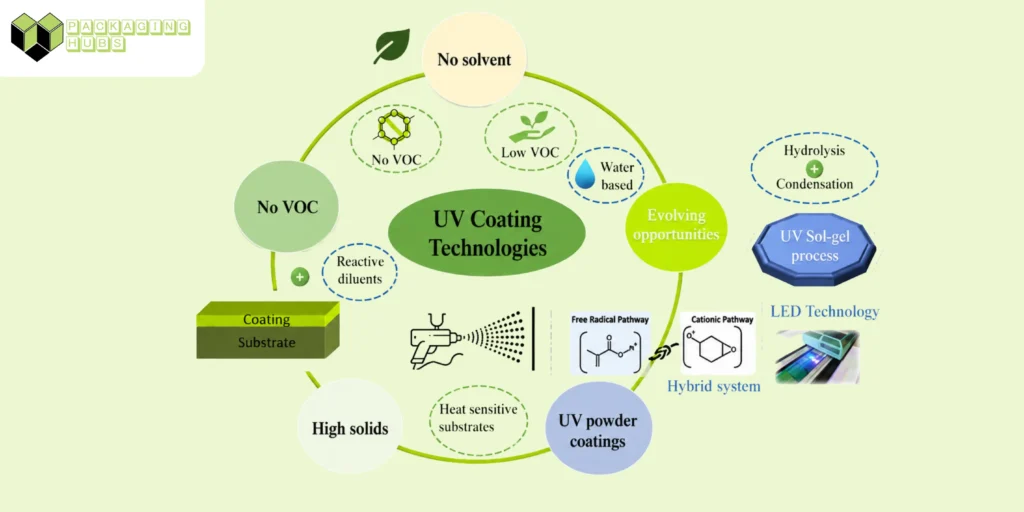
UV coating can support lower-emission production in some cases, but it should not be called environmentally friendly without proof.
Some UV curable coating systems may use little or no solvent compared with traditional solvent-based systems. However, coating chemistry, recyclability, energy use, curing equipment, waste handling, and supplier documentation all matter.
Searches such as environmentally friendly industrial coatings illinois show that buyers often connect coatings with sustainability. That does not mean every UV coating, UV lacquer, UV resin gloss, UV clear spray paint, or UV coating for packaging deserves the same claim.
A safer brand statement is specific. “Spot UV highlights the logo” is clear. “Low-VOC UV coating option available” should only be used when supplier data supports it. “Eco-friendly UV coating” should not be used as a casual claim.
UV Coating vs Other Packaging Finishes
UV coating is only one finish option. Brands should compare it with aqueous coating, lamination, and uncoated surfaces before choosing.
| Finish | Best Use | Main Strength | Main Limitation |
| UV coating | High gloss, spot UV, premium shine | Strong visual impact and fast curing | Can crack near folds and add cost |
| Aqueous coating | Everyday cartons and cost-effective protection | Practical and widely used | Less dramatic than UV gloss |
| Matte lamination | Luxury boxes and soft-touch packaging | Premium tactile feel | Adds film layer and cost |
| Gloss lamination | Bright retail packaging | Strong shine and film protection | May look too synthetic for some brands |
| No coating | Rustic kraft, writeable surfaces, natural packaging | Simple and tactile | Less surface protection |
| Dull UV | Refined premium cartons | Lower shine with protection | Less noticeable than gloss UV |
| Spot UV | Logos, patterns, product names | High-end contrast | Requires accurate registration |
This comparison shows why UV coating is valuable but not automatic. The right finish depends on packaging material, product category, artwork, cost, folding, and customer use.
Quick Decision Guide for Packaging Buyers
This table helps brands decide whether UV coating fits their packaging project.
| Project Factor | Choose UV Coating When | Avoid UV Coating When |
| Brand look | You want shine, contrast, or premium shelf impact | You want rustic, natural, or soft-touch packaging |
| Artwork style | Logos, patterns, dark colors, or product imagery need emphasis | Artwork is plain and UV adds little value |
| Folding needs | The design has few tight folds or coating knockouts are planned | Heavy coating crosses score lines |
| Writing needs | No writing is needed or an uncoated area is reserved | Customers or staff need to write on the package |
| Labels and barcodes | Label zones and barcode areas are planned | Gloss may cover scanning or sticker areas |
| Budget | Premium finish cost supports the brand position | Basic high-volume packaging must stay low-cost |
| Sustainability claims | Supplier documentation supports the claim | Highest recyclability or compostability is the main goal |
| Food packaging | Coating stays away from food contact or documentation supports use | Coating may contact food without documentation |
| Flexible packaging | Film-specific testing is available | Paperboard coating rules are being assumed |
This decision guide is designed for packaging buyers, not only print technicians. It connects finish choice to real production and brand decisions.
UV Coating for Packaging Across the USA
UV coating for packaging USA searches often come from brands comparing print finishes for retail, ecommerce, and promotional packaging.
coating printing Los Angeles projects often involve cosmetics, beauty boxes, entertainment packaging, gift boxes, and premium product sleeves. coating for packaging New York can support fashion packaging, luxury retail cartons, skincare boxes, jewelry inserts, and event packaging. UV coating printing Texas often serves Dallas, Houston, Austin, and statewide ecommerce sellers.
UV coating for printing Chicago may support food sleeves, health-product cartons, electronics packaging, supplement boxes, and retail inserts. Packaging UV Florida searches often come from Miami, Orlando, Tampa, and Jacksonville brands that need cosmetic packaging, gift packaging, and product sleeves.
UV coated paper California, UV spot gloss Atlanta, UV coating paper Dallas, UV gloss coating Houston, UV coated printing Phoenix, UV coating for packaging Miami, and UV coating printing Seattle are also common local search patterns.
Packaging Hubs supports businesses across California, Texas, Florida, New York, Illinois, Georgia, Arizona, Washington, Nevada, Ohio, Pennsylvania, New Jersey, North Carolina, Colorado, Oregon, Michigan, and other U.S. markets.
This local section helps connect the informational topic to real packaging buyers who search by city, state, finish, and product need.
How Packaging Hubs Helps Brands Choose UV Coating
Packaging Hubs helps brands choose finishes based on product use, not just surface appearance.
A cosmetic carton may need spot UV on the logo. A rigid gift box may need matte lamination with selective shine. A mylar pouch may need film-specific testing. A food carton may need careful coating placement. A basic shipping box may not need UV at all.
The goal is to make packaging look better while still working in production, shipping, retail, and customer use. That means considering substrate, ink, folding, labeling, barcode placement, food-contact needs, cost, and brand style.
Brands that need help comparing UV coating, UV varnish, dull UV, aqueous coating, lamination, or uncoated packaging can visit contact us and request finish guidance. Packaging Hubs can help match the finish to the product and artwork.
Final Thoughts: UV Coating Is a Strong Finish, Not a Default Finish
UV coating can make printed packaging more attractive, more polished, and more memorable.
It can improve color depth, create premium logo contrast, protect printed surfaces from light handling wear, and help packaging photograph better for ecommerce and social media. It is valuable for cosmetics, electronics, gifts, retail sleeves, rigid packaging, inserts, labels, and selected custom packaging projects.
Its drawbacks are also real. UV coating can crack near folds, make surfaces harder to write on, show fingerprints, add cost, complicate recycling claims, and require careful curing controls. It should be chosen for a clear packaging reason.
For brands, the best finish is not always the shiniest finish. The best finish is the one that supports the product, material, artwork, budget, customer experience, and brand promise.
Frequently Asked Questions
What is UV coating in printing?
UV coating in printing is a clear liquid finish applied over printed material and cured with ultraviolet light. It creates a hardened surface that can improve gloss, color depth, scuff resistance, and packaging appearance.
What is UV coating used for in packaging?
UV coating is used in packaging to add shine, protect printed artwork, highlight logos, improve shelf appeal, create spot gloss effects, and make boxes or inserts feel more premium.
What is UV spot gloss?
UV spot gloss is a selective UV coating applied only to certain areas, such as a logo, product name, pattern, or image. It creates glossy contrast against matte, dull, or uncoated backgrounds.
What is the difference between UV coating and UV varnish?
UV coating and UV varnish are often used in similar ways, but terminology can vary by printer. Both usually refer to UV-cured clear finishes applied to printed surfaces.
Is UV coating good for custom packaging?
UV coating is good for custom packaging when a brand wants shine, contrast, richer color, or stronger surface appeal. It is not ideal for every package, especially writeable, rustic, heavily folded, or cost-sensitive packaging.
What are the disadvantages of UV coating?
The disadvantages of UV coating include fold cracking, higher cost, fingerprint visibility, writing difficulty, barcode glare, recycling claim complexity, and the need for controlled curing during production.
Can UV coating crack on box folds?
Yes. UV coating can crack near folds or score lines if the coating is too thick or placed across tight creases. Coating knockouts and sample testing can reduce this issue.
Is UV coating waterproof?
UV coating can add some surface protection, but it should not be treated as fully waterproof packaging. Water resistance depends on coating type, paper stock, edges, seams, structure, and exposure conditions.
Can you write on UV coated paper?
Writing on UV coated paper can be difficult, especially with high-gloss coating. If writing is needed, the package should include an uncoated writing panel or label area.
Is UV coating safe for food packaging?
UV coating may be used on some food-related packaging surfaces, but direct food-contact suitability depends on the coating, ink, liner, barrier, supplier documentation, and intended use.
Is UV coated paper recyclable?
UV coated paper may be recyclable in some systems, but recyclability depends on coating chemistry, paper type, local recycling rules, and processing methods. Brands should avoid broad claims without documentation.